
Robotic Wheelchair
 The robotic wheelchair that follows your staff.
- One staff member leads up to three passengers
- Starts with one button. No mapping needed
- A trained caretaker stays with every passenger
What is GAROO
GAROO is a robotic wheelchair built by Doog for airports, hospitals, and other large facilities that move passengers or patients every day.
It runs on the same navigation technology as THOUZER, Doog's Mobile Robot, in wheelchair form. GAROO works in Follow-Me mode: it follows a staff member, so a person stays in charge of every journey.
GAROO was developed together with an airport operator, where it is used for passenger mobility services. Hospitals and healthcare centers are now working with Doog to explore GAROO, and some already use it in daily operations.
GAROO is built for organizations, not for personal use.

Up to 3
passengers per staff member
5 km/h
maximum speed
10 m
sensing radius
1 button
to start. No mapping.
Why GAROO
GAROO carries the passenger. The caretaker walks ahead with free hands and full attention, ready to guide, reassure, and help. Each does what they do best.
-
Mobility for the people who need it.
GAROO is designed for passengers and patients with real mobility needs, not as a novelty ride.
-
More journeys per staff member.
One staff member can lead up to three passengers per trip. The staff member sets the GAROOs up in a line: the first follows the staff member, and each one behind follows the one ahead.
-
A calmer journey for the passenger.
Passengers ride in a premium wheelchair with a trained caretaker beside them the whole way. If they need help, the help is already there.
-
Why a person stays in the loop.
If a passenger feels unwell or gets lost, a person can help right away. A robot cannot. GAROO keeps that person close by.
What GAROO solves
Fully autonomous wheelchairs sound like the natural next step. In practice, facilities that try them run into the same five problems. GAROO was designed around each one.
| The problem with fully autonomous wheelchairs | How GAROO handles it |
|---|---|
| Passengers may need help right away.Many people use wheelchair services because of health concerns. An unattended wheelchair leaves them waiting for assistance. | A staff member travels with the passenger, so help is immediate. |
| Busy facilities change by the minute.An autonomous wheelchair can lose track of its surroundings and stop, unable to continue. | GAROO follows a person, and the person decides the path through the crowd. |
| Low speed can work against the passenger.Autonomous wheelchairs run slowly for safety, which is a problem when a passenger has a gate to reach or an emergency to respond to. | GAROO moves at up to 5 km/h, keeping pace with the staff member. |
| It becomes an attraction, not a service.After launch, autonomous wheelchairs are often used by curious visitors rather than passengers with real mobility needs. | Staff assign GAROO to the passengers who need it. |
| Setup is long and costly.Mapping, geofencing, and systems integration add time and cost before the first journey. | GAROO starts with a single button. No mapping. Works in all wheelchair-accessible areas. |
Plans also change mid-journey. A gate moves, a passenger feels unwell. With GAROO, the staff member changes the route on the spot, so the passenger does not have to find their way back to the start.
How GAROO works
Follow-Me mode
GAROO uses Follow-Me, the same navigation mode used by THOUZER. A LiDAR sensor tracks the target ahead within a 10 m radius. GAROO does not need a map, markers on the floor, or a fixed route. It goes wherever the staff member goes.
For more than one passenger, the staff member places the GAROOs one behind the other and turns on Follow-Me for each. Then the first GAROO follows the staff member, the second follows the first, and so on, up to three passengers per trip.

- Staff member leads
- GAROO 1 follows the staff member
- GAROO 2 follows GAROO 1
- GAROO 3 follows GAROO 2


Getting started
-
Step 1: Turn on GAROO.
Switch on each GAROO you plan to use.
-
Step 2: Line up.
Place the GAROOs one behind the other in a straight line.
-
Step 3: Seat your passengers.
Invite each passenger into a GAROO and make sure their seat belt is fastened.
-
Step 4: Activate Follow-Me, one GAROO at a time.
Set Follow-Me on each GAROO in turn. Then lead the way: the first GAROO follows you, and each GAROO behind follows the one ahead.
The first trip is where staff learn the rhythm. As your team gets comfortable, you will find which routes and which passengers benefit most.
You don't need to start with all three. Begin by pushing one manual wheelchair with one GAROO following you. As you get familiar, add more GAROO to the line.
Safety
GAROO's first safety feature is a person. A trained staff member travels with every passenger, sees what is ahead, and can step in at any moment.
-
Human-led by design.
GAROO follows a staff member. It does not travel unattended.
-
Immediate assistance.
If a passenger feels unwell or needs to stop, the staff member is already there.
-
Real-time decisions.
The staff member can change the route, clear the way, or stop the journey on the spot.
-
Seat belt.
Every passenger is belted in before GAROO moves.
-
Passenger exit detection.
The LiDAR sensor detects a passenger's feet if they try to get out while GAROO is moving. GAROO stops and sounds an alarm.
-
Manual joystick at the back.
Staff can take direct control of GAROO when needed, using the joystick on the back of the wheelchair.
-
Controlled speed.
Maximum speed is 5 km/h.
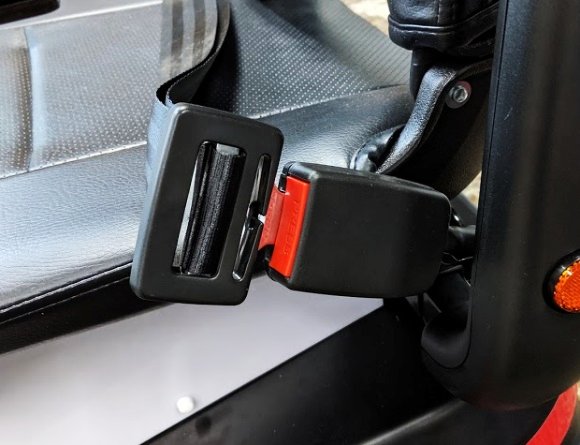
GAROO stops when the seat belt is released. 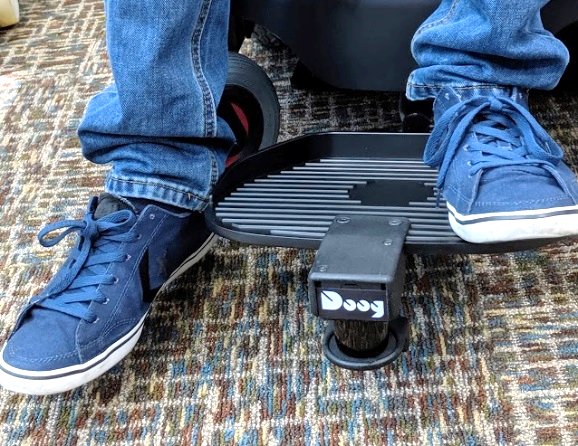
GAROO stops when a passenger tries to get out. 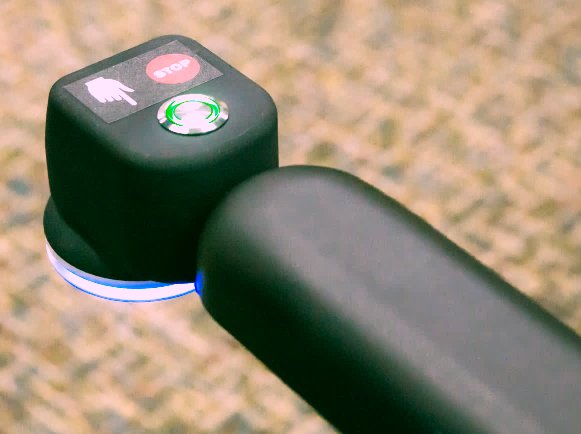
Passengers can only press the STOP button. 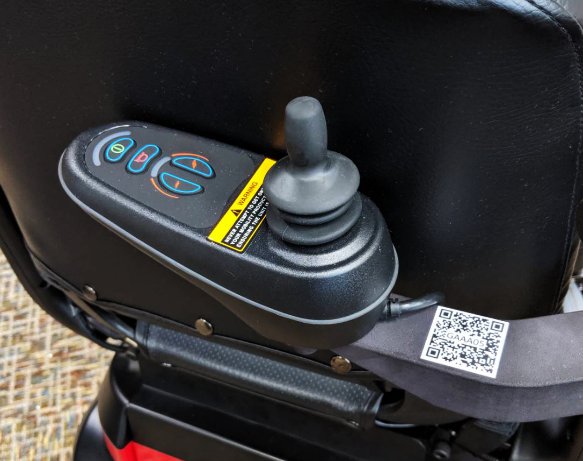
The joystick sits at the back, for staff use only.


Specifications
| Specification | GAROO |
|---|---|
| Dimension (W x L) | 580 x 825 mm |
| Seat height | 460 to 510 mm (from ground) |
| Seat width | 460 mm |
| Weight capacity | 100 kg |
| Total weight | ~40 kg (without battery) ~52 kg (with battery) |
| Motor | 2 x DC24V, 120 W, 4000 rpm |
| Battery | Lead-acid battery 12V, 20Ah x 2 pcs |
| Sensing coverage | Radius 10 m |
| Running distance | 10 to 15 km |
| Max. gradient | 6° |
| Max. speed | 5 km/h |
| Charging time | ~8 hours |
| Navigation mode | Follow-Me |


FAQ
Is GAROO a self-driving wheelchair?
Not as standard. GAROO follows a staff member in Follow-Me mode. A person leads every journey, which is what lets passengers get help right away.
Can GAROO move autonomously?
Doog's navigation technology includes Memory Trace navigation. If your facility needs autonomous movement, contact Doog to discuss your requirements.
Does GAROO need a map of my facility?
No. GAROO starts with a single button and needs no mapping, floor markers, or fixed route.
Where can GAROO operate?
GAROO can operate in all wheelchair-accessible areas. It follows the staff member, so it can go wherever your staff can lead it within the specifications above, such as a maximum gradient of 6°.
How many passengers can one staff member handle?
Up to three passengers per trip. GAROOs follow each other in a line, and the first follows the staff member.
How fast does GAROO move?
Up to 5 km/h.
How far can GAROO travel on one charge?
10 to 15 km. A full charge takes about 8 hours.
What is the maximum passenger weight?
100 kg.
Can I buy GAROO for personal use?
GAROO is designed for organizations such as airports, hospitals, and large facilities. It is not offered as a personal mobility device.
Where is GAROO used today?
GAROO was developed with an airport operator and is used there for passenger mobility services. Hospitals and healthcare centers are also working with Doog to explore GAROO, and some already use it in daily operations.
How much does GAROO cost, and how long does delivery take?
Pricing and delivery depend on your requirements. Contact Doog to discuss your facility.
Next steps
Get in touch.
Tell us about your passengers, your staff, and your spaces.